|
John Mitchell & Associates, Sydney, Australia
This paper reports on a national study of telemedicine and e-health
in Australia, From telehealth to e-health: the unstoppable rise
of e-health (Mitchell, 1999). The study shows that the positioning
of telemedicine as part of e-health is adding considerably to the
justification of the cost effectiveness of telemedicine.
In 1998, John Mitchell & Associates prepared a report for the
Commonwealth Government of Australia From Fragmentation to Integration:
the Telemedicine Industry in Australia. The 1998 report argued
that telemedicine needed to be integrated with mainstream health,
if the full benefits of telemedicine were to be realised. Extensive
consultations and five national workshops to discuss the 1998 report
led to the preparation of a new study in 1999 on the relationship
between telemedicine and e-health. The report was prepared for the
National Office for the Information Economy, Department of Communications,
Information Technology and the Arts.
The study (Mitchell, 1999) explores the view that, with the relentless
convergence of technologies and the consequent increase in ability
to perform multiple functions with those technologies, it is unwise
to promote telemedicine in isolation from other uses of technologies
in health care. The combination of information technologies and
telecommunications is having a significant effect on health care,
and the impact of this convergence on telemedicine needs to be clarified.
Major sources of information for the e-health report (Mitchell,
1999) were the presentations and discussions at the five national
workshops held from November 1998 - May 1999 to discuss the findings
of the report on telemedicine (Mitchell, 1998). Other methodologies
included the identification of a range of Australian and overseas
e-health case studies; searches of the Internet; and a review of
current literature.
Mitchell (1999) pays considerable attention to clearly distinguishing
between telemedicine, telehealth, health informatics, the information
economy, e-commerce and e-health. The following table summarises
common definitions of these terms.
|
|
|
|
telemedicine
|
a system of health care delivery
in which physicians examine distant patients through the use
of telecommunications technology (Preston, 1993) |
|
telehealth
|
health care at a distance
(Health On Line, 1997) |
|
health informatics
|
an evolving scientific discipline
that deals with the collection, storage, retrieval, communication
and optimal use of health related data, information and knowledge
(Health Informatics Society Australia website) |
|
information economy
|
the new world of social and
commercial interaction, brought about by advances in information
technology (Towards an Australian Strategy for the
Information Economy, 1998) |
|
e-commerce
|
every type of business transaction
in which the participants (i.e. suppliers, end users etc.) prepare
or transact business or conduct their trade in goods or services
electronically (Australias e-commerce Report
Card, 1999) |
|
e-health
|
a new term needed to describe
the combined use of electronic communication and information
technology in the health sector
the use in the health
sector of digital data - transmitted, stored and retrieved electronically
- for clinical, educational and administrative purposes, both
at the local site and at a distance (From Telehealth
to E-health, the Unstoppable Rise of E-health, 1999) |
In Australia, the period 1998-1999 saw a significant rise in interest
in the field of e-commerce, with the focus on business-to-business
electronic communication. In the report by Mitchell (1999), e-health
is taken to be the health industrys component of e-commerce:
E-health is a new term needed to describe the increasing use
of electronic communication and information technology in the health
sector.
Telemedicine is the term used to describe the use of telecommunication
technologies for the provision of medical services to distant locations.
E-health is a more general term that describes the use of both telecommunication
and information technologies, for the delivery of health services
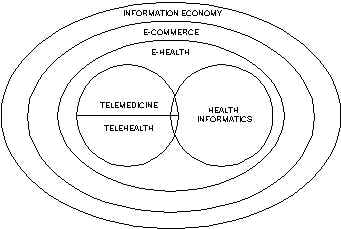
both at a distance and locally. Hence, e-health is the overall,
umbrella field that encompasses telemedicine and telehealth. The
following diagram shows the relationship of the information economy
and e-commerce to e-health, telemedicine and telehealth.
 |
Cost effectiveness analysis contrast alternatives in terms
of their relative contribution towards a specific objective.
(Dept. Finance, 1991, p. 2). Mitchell (1999) took the view that
the objective of using technology is to improve the delivery of
health services. The alternatives are to use telecommunication technologies
on their own (e.g. telemedicine) or to use a combination of telecommunication
and telecommunication technologies (e-health). These alternatives
are discussed below.
Mitchell (1999) identified a range of initiatives in the Australian
health sector that involve combinations of telemedicine and information
technology. These include rural Victorian nurses making house calls
armed with laptops that can be connected to databases at headquarters,
via a mobile phone; highly qualified cardiology staff answering
telephone calls from around Australia in the Adelaide call centre
of the National Heart Foundation, with the support of a powerful
database; renal clinicians simultaneously videoconferencing and
accessing local, clinical databases; radiologists in South Australia
using a combination of teleradiology and digital archiving systems;
and general practitioners in Queensland accessing powerful, new
pharmacy databases and producing electronic scripts.
Generally, the Australian case studies in the report (Mitchell,
1999) involve the use of both telecommunication technologies such
as videoconferencing, the telephone or the Internet together with
information technologies such as computer databases and other image
capture, electronic ordering, storage and retrieval systems. Besides
this use of combinations of information and telecommunications technologies,
the use of the Internet is starting to expand the boundaries of
e-health. Internet case studies in the report record such Net-based
activities as GP communication with hospitals and pharmacists via
the Net; provision of professional development for remote health
professionals using videoconferencing and the Net; and patients
communicating with health professionals via the Net.
The following table summarises the nineteen Australian case studies
profiled in Mitchell (1999).
|
|
|
|
|
|
Network of general practitioners, Pathology Laboratories,
Pharmacies, Hospital, etc.
|
Australian Capital Territory Division
of General Practice; General Practice Computer Group, Australian
Medical Association; Telstra |
Australian Capital Territory |
encrypted email, IP enabling services,
databases, telecommunication technologies |
|
Regional E-health
|
Optus Communications |
Bendigo, Victoria |
telecommunication technologies, databases,
software |
|
Renal Conferencing
|
The Queen Elizabeth Hospital, Adelaide
and five other hospitals in SA and NT |
South Australia/Northern Territory |
videoconferencing; radiology and
pathology slides accessed from local area network |
|
Hospital without Walls project
|
CSIRO, Ryde, Sydney |
New South Wales |
sensors, radio, PC, databases, alarms,
cable television, Internet |
|
DocTel
|
DocTel, Adelaide |
South Australia |
satellite transmission; videoconferencing;
www |
|
National Mental Health Call Centre
|
Mental Health Call Centre for Rural
and Remote |
Sydney/National |
call centre telephony; database |
|
GP electronic communication
|
The Competitive Advantage. Medi-safe
Communications. |
Queensland |
encrypted email |
|
WA Government Health Call Centre
|
High Performance Healthcare |
Western Australia |
call centre telephony, database |
|
Telecardiology
|
Concord General Hospital |
New South Wales |
mobile phone with fax display |
|
General Practitioners using IT/Internet
|
Health Communication Network |
New South Wales |
www, databases, software |
|
Internet education
|
CMENet; Queensland Rural Divisions
Coordinating Unit |
Queensland |
www and CD ROM |
|
Internet Information
|
Med-E-Serve |
Queensland |
www, databases, software |
|
Teleradiology and Videoconferencing
|
Womens and Childrens
Hospital, Adelaide; Alice Springs Hospital, Northern Territory |
South Australia/Northern Territory |
teleradiology; videoconferencing |
|
Cardiology Call centre
|
National Heart Foundation, Adelaide |
Adelaide/National |
call centre telephony; database |
|
Use of mobile phones and hand-held computers, dialing databases
and emailing pharmacists from patients homes
|
Royal Society of District Nursing |
Victoria |
mobile phones; hand-held computers;
databases |
|
Pharmaceutical electronic ordering
|
Project Electronic Commerce and Communications
for Healthcare (PECC) |
National |
secure, encrypted email; electronic
catalogue; Extranet gateway trading; electronic funds transfer
(EFT); electronic logistics |
|
Telemedicine centre
|
Johnson and Johnson |
New South Wales |
www; video editing; videoconferencing |
|
Use of videoconferencing and Internet for Mental Health Telehealth
Professional Development
|
Womens and Childrens
Hospital |
South Australia/Northern Territory |
ISDN videoconferencing; videotapes;
www |
|
Links to Antarctic
|
Tasmania/Antarctic |
Tasmania |
satellite transmission; email; videoconferencing;
Internet |
In investigating the above case studies, Mitchell (1999) found
that with the relentless convergence of technologies and with the
consequent increase in ability to perform multiple functions with
those technologies, telehealth is becoming part of e-health. The
following diagram shows the relationship between the two sets of
technologies and e-health.
Mitchell (1999) also found that the cost effectiveness of telehealth
is currently limited by the positioning of telehealth outside of
the mainstream of health care. For some critics, telehealth is seen
as a peripheral activity and as a novelty area for technological
enthusiasts. The cost effectiveness of telemedicine will not be
improved unless the perception that it is an 'add on' is changed.
Telehealth is more likely to be cost effective and to be sustained
if is seen as part a larger domain, e-health.
In contrast to the difficulty many telehealth projects have in
becoming permanent aspects of health organisations, there are strong
business cases emerging in many areas of e-health, such as in the
use of call centres and online health information services. These
business cases indicate that e-health services are driven by business
principles and are fast becoming part of mainstream health care
delivery. E-health business cases can incorporate and sustain telehealth
activities.
Mitchell (1999) found that there are a number of drivers of e-health,
including increased efficiencies from improvements in business processes,
the improved quality of care and demand from consumers. Health care
lends itself to the strategic application of online technologies
because of its size, the current inefficiencies of paper-based records,
the intense need for up-to-date information to provide quality health
care and because consumers have indicated that they are keen to
use the Net.
Australias special challenges of distances and the lack of
medical practitioners in rural areas are obvious incentives for
expanding e-health. Other Australian drivers behind these developments
include the realisation of the clinical benefits of using combinations
of information and telecommunication technologies to provide improved
or new services; the mounting pressure from consumers that the clinical
world take advantage of the digital revolution; and the ubiquitous
growth of the Internet.
This repositioning of telemedicine and telehealth as part of e-health
will add to the justification of the cost effectiveness of telemedicine
and telehealth. It will also add to the expansion of telemedicine
and telehealth beyond their current parameters. Mitchell (1999)
does not advocate an end to the use of the term telemedicine or
telehealth. The report advocates that e-health is an important,
overarching term and that both telemedicine and telehealth have
more chance of being supported if they are seen as part of a comprehensive,
integrated e-health plan.
The identification of these current e-health activities and the
presence of these relentless drivers substantiate the title of the
report, the From Telehealth to E-Health: the Unstoppable Rise of
E-health (Mitchell, 1999).
There are some regulatory and behavioural barriers to the successful
take-up of e-health services in Australia. However, many of the
barriers to the development of e-health can be removed, through
policy changes, business strategies and the innovative use of new
and emerging technologies. For instance, barriers that are now being
addressed include concerns about the privacy of health data; inter-connectivity
between different technologies; the need for technical standards;
and the remuneration of health professionals using e-health strategies.
Another barrier being addressed is the low level of knowledge about
information and telecommunications technologies among many health
professionals.
Mitchell (1999) recommends that the Australian Government and industry
should continue to work together to ensure that technology research
and development leads to the rapid commercialisation of e-health
technologies. There is also a need for industry to work with health
customers to overcome distrust and to explain the new business models
for e-health.
The cost effectiveness of both telehealth and telemedicine improves
considerably when they are part of an integrated use of telecommunications
and information technology in the health sector.
A Strategic Framework for the Information Economy: Identifying
Priorities for Action,Department of Communications, Information
Technology and the Arts, December 1998
Australian New Zealand Telehealth Committee, http://www.telehealth.org.au
Australias e-commerce Report Card, Department of
Communications, Information Technology and the Arts, April 1999
Department of Finance (1991), Handbook of Cost-Benefit Analysis,
Canberra
Health Informatics Society of Australia website, http://www.hisa.org.au
Health On Line. A Report on Health Information Management and
Telemedicine, The House of Representatives Standing Committee
on Family and Community Affairs, October 1997
Mitchell, J. (1998), Fragmentation to Integration: the Telemedicine
Industry in Australia, Department of Industry, Science and Tourism,
Canberra
Mitchell, J. (1999), From telehealth to e-health: the unstoppable
rise of e-health, National Office for the Information Economy,
Dept of Communications, Information Technology and the Arts, Canberra
Preston, J. (1993), The Telemedicine Handbook. Improving Health
Care with Interactive Video. PictureTel Corporation, Danvers,
MA
BA (Hons), Dip Ed, Grad Dip Bus Admin, M Ed Admin, EdD (cand.),
AFAIM
|